








Repairing a hydraulic cylinder and need to replace a seal, but don't know the reference? To find the right seal, start by identifying its function, its dimensions and its material. This guide explains how, and how to use the Hidro Orfão seal finder.
1. Where it works
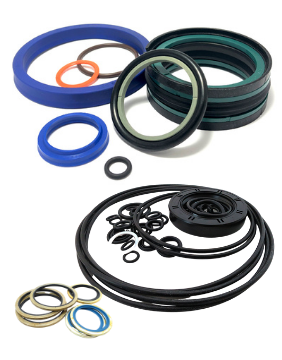
| Type | What it does | In our shop |
|---|---|---|
| Rod seal | Seals the rod in the front gland (seal housing) of the cylinder; holds the oil under pressure | Rod seals |
| Piston seal | Separates the two chambers of the cylinder | Piston seals |
| Wiper | Cleans the rod as it retracts, so no dirt gets into the cylinder | Wipers |
| Guide ring | Guides the rod or the piston and prevents metal-to-metal contact | Guide rings |
| O-ring and back-up ring | The O-ring seals static connections and some dynamic applications, depending on the operating conditions. The back-up ring is a support: it stops the O-ring being pushed into the gap and does not replace the O-ring | O-rings and back-up rings |
| Shaft seal | Seals rotating shafts (pumps, motors, gearboxes) | Shaft seals |
| Sealing washer | Seals parallel threads (BSP, metric) | Sealing washers |


Double-acting piston: choose the seal carefully. In a double-acting cylinder the seal must work in both directions. You can use a double-acting piston seal or, in some configurations, two single-acting seals fitted in separate grooves. In that case it is essential to fit them the right way round and to prevent pressure building up between the seals, which can cause damage and premature failure.
2. The dimensions
- Rod seal: rod diameter (d), groove diameter in the gland (D) and groove width (H).
- Piston seal: cylinder bore (D), groove bottom diameter on the piston (d) and groove width (H).
- O-ring: inner diameter (d) and cord thickness (H).
Important: whenever possible, measure the rod, the bore and the seal groove. A used seal may be deformed, worn or swollen. Besides the dimensions, check the profile and the groove configuration: two seals with similar dimensions are not necessarily interchangeable. The groove size is not necessarily the same as the physical size of the removed seal, especially on polyurethane seals, asymmetric profiles and PTFE seals with an O-ring: a seal identified as 30 × 40 × 7 may have a physical height slightly different from the nominal groove width.
The finder lets you search for approximate sizes, which helps to identify possible alternatives. However, the dimensions shown must be confirmed before fitting.
3. The material
The temperatures shown are guide values, not universal limits. The choice of material must also consider the fluid, the pressure, the speed of movement and the specific features of the seal. Always check the limits given by the manufacturer.
| Material | Temperature (guide) | Good for | Limitations and precautions |
|---|---|---|---|
| NBR (nitrile rubber) | -30 to +110 °C | Mineral oils and some biodegradable fluids, once compatibility is confirmed. The standard material in hydraulics | Non-mineral brake fluids, fuels high in aromatics |
| HNBR | -30 to +130 °C | Higher temperatures than NBR, with better resistance to ageing, ozone and thermal wear | — |
| FKM (Viton) | -20 to +200 °C | High temperatures, mineral oils, hydrocarbons, many chemicals | Ethers and ketones. Compatibility with hot water, steam and some hydraulic fluids depends on the compound |
| Polyurethane (PU) | -35 to +100 °C; some grades -45 to +110 °C | Wear and extrusion resistance; mineral oils and greases | Brake fluids, polar solvents, acids and alkalis. Resistance to water (hydrolysis) depends on the type of polyurethane |
| PTFE | -200 to +260 °C | Low friction, almost all fluids | +260 °C is a typical limit of the material, not necessarily of the complete seal |
| Polyamide (PA66) | -20 to +180 °C | Back-up rings and guides | +180 °C is not, in general, an acceptable continuous operating temperature |
| POM (acetal) | -40 to +130 °C | Back-up rings and guides | Acids and chlorine. +130 °C may be too high for continuous use |
Indicative information. Check the part marking or the manufacturer's data sheet.
The material cannot be reliably identified by colour or appearance. In our shop, sizes without a confirmed material are shown as "Not specified". If the material matters for your application, ask us to confirm it.
Safety: when exposed to excessive temperatures, fire or thermal decomposition, fluorinated materials such as FKM and PTFE can release toxic and corrosive substances. Do not touch burnt or degraded seals without suitable protection. If exposure is suspected, seek medical advice.
Got another brand's reference?
The seal finder lets you identify equivalent profiles by the designations used by other manufacturers. For example, K38, SD and RSD may correspond to the TTS/L family, while UP may correspond to the TTU profile. Always confirm the dimensions, the material and the operating conditions before replacing a seal.
Sources
- Technical documentation from seal manufacturers such as Aston, Guarnitec and SKF.