- Products
- Hydraulic seals
- Hoses and fittings
- Filtration
- Measurement and sensors
- Valves
- Directional valves
- Proportional valves
- Relief valves
- Check valves
- Overcenter Valves
- Sequence Valves
- Pressure reducing valves
- Flow restrictors
- Flow Regulators
- Flow Dividers
- High-Low Valves
- End-of-stroke valves
- Ball Valves
- Other Valves
- Manifold blocks and subplates
- Monoblock and sectional valves
- Coils, connectors and electronics
- Pressure intensifiers
- NEM - Cartridge valves
- Hidro Orfão Systems
- Pumps
- Transmission
- Motors
- Accumulators
- Cooling
- Mini power packs
- Crimping machines
- Industrial consumables
- Pneumatics – End of stock
- Cilindros pneumáticos
- Kits de cilindro e vedantes
- Acessórios para cilindros
- Válvulas direcionais e eletroválvulas
- Válvulas manuais e mecânicas
- Comandos de painel
- Bobinas e fichas
- Eletroválvulas para fluidos
- Tratamento de ar
- Ligações instantâneas (push-in)
- Ligações em latão e de compressão
- Reguladores de caudal e antirretorno
- Silenciadores
- Pneumatic tubes
- Brands
- Utilities
- Advanced search










Subcategories
-

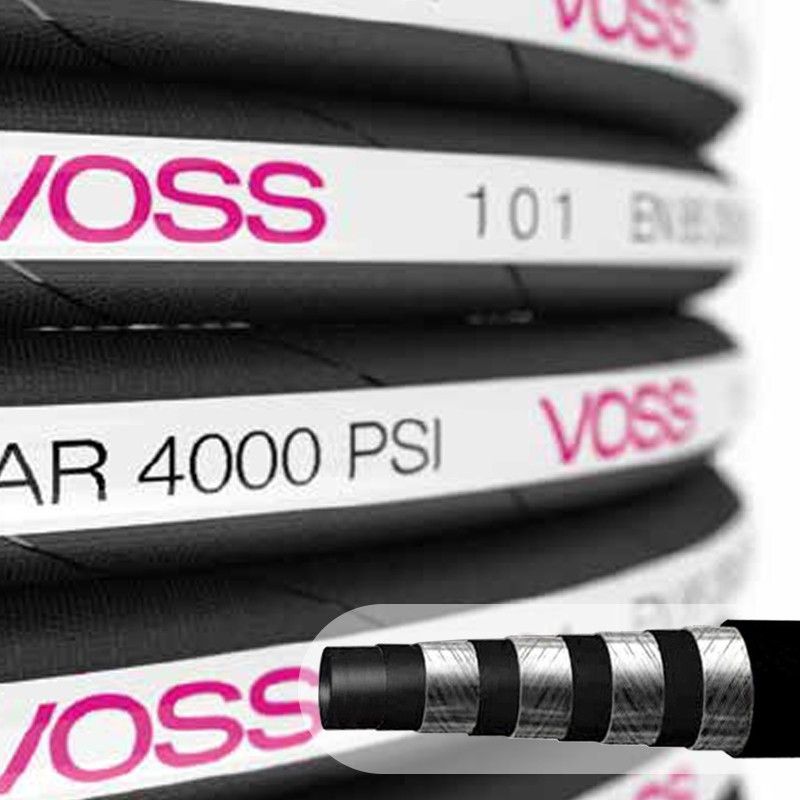
Hoses
Low, medium and high pressure hydraulic hose, suction hose, zinc-plated steel tube for rigid lines and hose protection. Organised into hydraulic hose, protection, steel tube, suction and other.
How to choose a hose:
- Inside diameter: the nominal size (DN), in inches or millimetres. Too small a diameter heats the oil and wastes pressure; the diameter calculator gives the minimum diameter for the flow.
- Working pressure: choose a hose with a working pressure equal to or above the maximum pressure of the circuit, including peaks.
- Standard and construction: the standard (for example 1SN, 2SN, 4SH) is printed on the hose and tells you the pressure and type of reinforcement. The number of wire layers alone is not enough to know the standard.
The fitting must match the hose: the manufacturer's crimping chart says which fitting and ferrule to use for each hose. For high-pressure hoses with several wire layers (such as 4SH) there are also Interlock fittings.
Prefer the hose already crimped? The custom hose assembly builds it with the fittings and length you choose.
Technical guide: How to identify hose fittings
-

Hose fittings
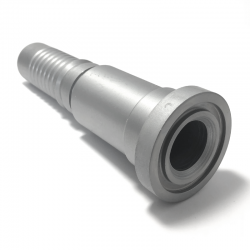
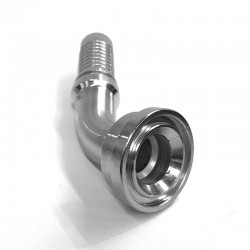
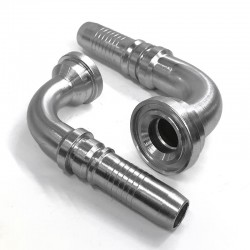
Fittings to crimp onto hydraulic hoses, with their ferrules. We stock BSP, metric DIN (L and S series), JIC, ORFS, JIS, French, SAE 3000 and 6000 flange and SuperCAT, banjo, tube, flat-seat BSP and connector fittings, straight, 45º and 90º, and Interlock versions for high-pressure hoses.
How to identify the connection:
- BSP: inch thread, 60º cone;
- Metric DIN: fine metric thread, 24º cone (with or without O-ring); L (light) and S (heavy) series for different tube diameters;
- JIC: UNF thread, 37º cone;
- ORFS: flat face with O-ring on the male;
- SAE flange: no thread, held by four bolts; code 61 is for 3000 psi and code 62 for 6000 psi.
Measure the outside diameter of the male thread (or inside diameter of the female) with a caliper and count the threads per inch or the pitch in millimetres. The guide How to identify hose fittings has an identifier that does this for you.
The fitting must be the right series for the hose: check the crimping chart. The hose fitting finder searches by connection and size, and the custom hose assembly builds the complete hose.
Technical guide: How to identify hose fittings
-

Adapters
- Discover here our adapters and accessories
- in Zink-Nickel finish for hydraulics.
Technical guide: BSP and NPT threads: how to identify them
-

Clamps
Single and twin tube clamps, weld plates and metal clamps for securing hydraulic tubes and hoses. Select by tube outside diameter.
-

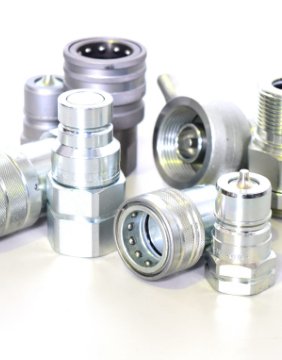
Hydraulic Quick Couplings
Hydraulic quick couplings to connect and disconnect hoses without losing oil, male and female, in the standards most used on agricultural, forestry and construction machinery and in industry:
- ISO-A (ISO 7241-A) and ISO-B;
- Flat face, SAE flat face and screw-type flat face, which let in less dirt and lose less oil when disconnected;
- ISO 14541, Faster NV, Tema T, TNV, Roflex, PVS, PVS-F and VCR;
- Heavy-duty for hard work and dust caps and protection.
How to choose: two couplings of different standards do not connect to each other, even with the same thread. First check the standard of the coupling already on the machine (often marked on the body), then the size and the thread of the connection to the hose or adapter. If the coupling is connected with pressure in the circuit (for example on a tractor with the engine running), choose a model designed for connection under pressure.
To identify the thread on the other side, see the guide BSP and NPT threads.





Are you an OEM? Reseller? Workshop?